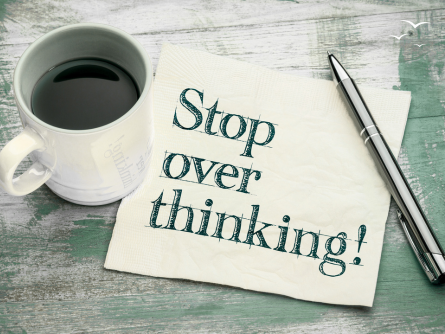
How to stop overthinking and actually get things done
Written by Amy Orsini, Reiki Master Teacher, Sound Practitioner & Life Coach at Three Little Birds, Purley, London.
Overthinking is one of those things that can look quite productive from the outside, can’t it?
You’re researching. You’re planning. You’re weighing things up. You’re considering every possible outcome. You’re being responsible. Sensible. Prepared.
Except sometimes you’re not really being prepared at all. Sometimes you’re just going round and round in your own head, making the thing bigger and bigger until it feels far too complicated to begin.
And I say that with love, because I know this pattern very well. I am an overthinker in recovery. Honestly, give me any topic and I can overcomplicate it for you. Need a new pair of shoelaces? Wonderful. Let’s research the colour, the length, the material, whether they should be waterproof, whether white or cream is better, whether anyone has written a blog comparing the top ten shoelaces of the year. I wish I was joking. I’m only half joking.
The thing with overthinking is that it often comes from a good place. It can come from wanting to get things right. It can come from caring deeply. It can come from wanting to avoid mistakes, avoid embarrassment, avoid failure, avoid letting people down. Sometimes it’s linked to anxiety, perfectionism, fear of failure, fear of success, overwhelm, low self-esteem or that feeling of needing to control something because everything else feels a bit too much.
So I’m not here to tell you off for overthinking. I don’t think that helps. If you’re an overthinker, you’ve probably already given yourself a hard enough time, thank you very much. What I do want to do is help you notice when your thinking has stopped being useful and started keeping you stuck.
Because at some point, my friend, we have to stop thinking about the thing and actually do the thing.
Overthinking often means overcomplicating
When we overthink, we often overcomplicate. A simple task becomes a project. A project becomes a huge life decision. A huge life decision becomes something we quietly place on the “too hard” pile and promise ourselves we’ll deal with tomorrow.
And then tomorrow comes, and it still feels too hard.
This is where overwhelm and overthinking are so closely linked. The more complicated something feels, the less likely we are to begin. Our brain looks at the task and says, “Absolutely not. Too much. Too hard. Let’s make tea instead.”
Which, to be fair, is often my brain’s solution to most things.
But the way through overthinking is usually not more thinking. It’s simplifying.
I find it really helpful to break the task down until it feels almost impossible not to do it.
Not just “make it manageable” - make it tiny. Make it so easy that your brain doesn’t have time to turn it into a whole dramatic production.
So instead of “clean the bathroom”, it might be: get the spray, get the cloth, walk to the bathroom, wipe the sink. That’s it. That’s the beginning. You can keep going if you want to, but the first step needs to feel small enough that you can actually take it.
There’s a tool called Goblin.ai that can help with this, especially if breaking tasks down feels hard for you. You type in the task and it breaks it into steps. Lovely. No need to sit there trying to create the perfect cleaning strategy when really you just need someone, or something, to say: pick up the cloth, Amy.
Action over perfection
Perfectionism is sneaky because it can make us feel like we have high standards when actually, sometimes, we’re just scared to begin.
And again, I say that as someone who fully recognises this in herself. I like things to be done properly. I like detail. I like thoughtfulness. I like things to feel considered. That’s a lovely quality in many ways, especially when you’re creating experiences like Reiki sessions, sound baths, courses or coaching. But if the desire to do something well stops you from doing it at all, it’s no longer helping.
This has been one of the biggest lessons of running my own business. If I had waited until I felt like an expert before offering my first Reiki session, I wouldn’t be where I am now. If I had waited until I knew everything before holding my first sound bath, teaching my first course or recording my first podcast, I’d still be sitting here with a notebook full of ideas and nothing out in the world.
You have to make it exist first. Then you can tweak it.
That’s the bit overthinkers often forget. You can’t improve something that only exists in your head. You can think about it beautifully, plan it beautifully, colour-code it beautifully, buy a lovely notebook for it, but at some point it needs to become real.
And real things are allowed to be imperfect.
Good enough is good enough
This might make the perfectionist part of you twitch, but good enough really is good enough.
I don’t mean careless. I don’t mean sloppy. I don’t mean doing things with no love or attention. I mean releasing the idea that everything has to be perfect before it can count.
Sometimes 70% or 80% is enough to move you forward. Sometimes done is enough. Sometimes the thing you’re spending hours worrying about is not the thing that will make the biggest difference anyway.
This is where the 80/20 rule is really helpful.
The idea is that 20% of your effort often creates 80% of your results. I find this fascinating and, if I’m honest, slightly annoying, because it means quite a lot of the things I spend time thinking about are probably not as important as my brain thinks they are.
Think about your wardrobe. You might have clothes for all sorts of possible occasions, because obviously we need to be prepared for every version of ourselves that might exist one day. But most of the time, you probably wear the same small group of things on repeat.
The same thing happens with your to-do list. Not everything on there matters equally. Some things will move the needle. Some things will bring relief. Some things will close a loop that’s been taking up far too much room in your brain. And some things are just preferences that have somehow dressed themselves up as urgent responsibilities.
Stop turning preferences into musts
This is a big one. Overthinkers are very good at turning preferences into musts.
I 'should' do that. I 'need' to sort this. I 'must' get that done. I 'have' to reply. I 'should' really organise that cupboard. I 'need' to research the best way to start. I 'must' make a better plan before I begin.
Do you, though?
Sometimes yes, of course. Some things really do need doing. But many things are 'coulds,' not 'musts.' “I could do that” feels very different from “I have to do that.” It gives you choice. It gives you space. It lets your nervous system unclench a little.
So next time you catch yourself saying “I should”, try changing it to “I could.”
I could clean the bathroom. I could reply to that email. I could go for a walk. I could work on that idea. I could start with ten minutes.
It’s subtle, but it changes the energy. Suddenly you’re not trapped under the weight of another demand. You’re choosing your next step.
And that matters, because when we feel like we have choice, we’re much more likely to move from a calmer place.
Limit your choices
Too many choices are not helpful for an overthinking brain. Too many choices can send us into a spiral of “what if I choose wrong?” and “what if there’s a better option?” and “what if I need to research this for another three days?”
This is why we limit choices for children. We don’t usually say, “What would you like to do with your entire day?” because that way chaos lies. We say, “Would you like this or this?” Two options. Both acceptable. Everyone survives.
Try doing the same for yourself.
Instead of staring at a huge list and asking, “Where do I start?”, ask: What can I delete? What can I delegate? What can I automate? What can only I do? What will actually move the needle?
Then choose one thing. Maybe two. Three maximum if you’re feeling fancy.
The point is not to complete your entire life admin list by lunchtime. The point is to reduce the noise enough that you can begin.
Use a timer
I love a timer for overthinking because it gives your brain a boundary. If you say, “I need to clean the whole house,” your brain may quite reasonably decide to leave the building. But if you say, “I’m going to do ten minutes,” that feels different.
Ten minutes is doable. Ten minutes is not forever. Ten minutes gives you a little deadline, and deadlines can be magic for overthinkers because they reduce the amount of time available for spiralling.
You can use your phone, a visual timer, an alarm, whatever works for you. Pick the task, set the timer, and go.
And here’s the thing: if you stop after ten minutes, you’ve still done ten minutes more than you would have done while thinking about doing it. That counts. If you keep going, fine. If you don’t, also fine.
We are not aiming for perfect. We are aiming for movement.
Make it easy to succeed
One of the simplest ways to stop overthinking is to set yourself up in advance.
If I want to work out first thing in the morning, I put my workout clothes next to the bed. Then when the alarm goes off, I don’t need to have a full conversation with myself about whether I feel like exercising. I just get up, put the clothes on and move my body.
Because if I’m wearing workout clothes, I’m much more likely to work out. If I’m wearing pyjamas, I’m much more likely to make a cup of tea and sit on the sofa. Both are valid life choices, but only one helps me do the thing I said I wanted to do.
So make the thing easier. Put your shoes by the door. Put the notebook on your desk. Open the document before you finish for the day so it’s ready when you come back. Get the ingredients out. Write the first sentence. Make the next step obvious.
Your future self will thank you.
Be kind to yourself
I want to end with this because it matters.
If you overthink, you’re probably not lazy. You’re probably not incapable. You’re probably not broken. You’re probably a well-intentioned person trying to do your best with what you have, where you are.
So please don’t turn this into another reason to be mean to yourself. That won’t help. Shame rarely creates the kind of action we actually want. It might push us for a bit, but it doesn’t feel good, and we are allowed to feel good. In fact I think we're supposed to feel good - most of the time, at least.
The aim here is not to force yourself into productivity. It’s to bring your thoughts, your energy and your attention back to what matters. Because when your mind is scattered, your energy can feel scattered too.
So simplify. Choose one thing. Make it smaller. Set a timer. Begin before your brain talks you out of it.
Good enough is good enough, my friend.
Make it exist.
You can tweak it later.
If this blog post resonated with you, listen to episode 17 of The Three Little Birds Podcast, where I talk more about overthinking, perfectionism and how to move from mental spiralling into simple action.
If your mind has been feeling especially busy lately, Reiki, sound baths or coaching can be a beautiful place to come back to yourself and feel a little lighter.
Have a wonderful day, my friend,
Amy
💜🤟
If you liked this post, you may also enjoy: